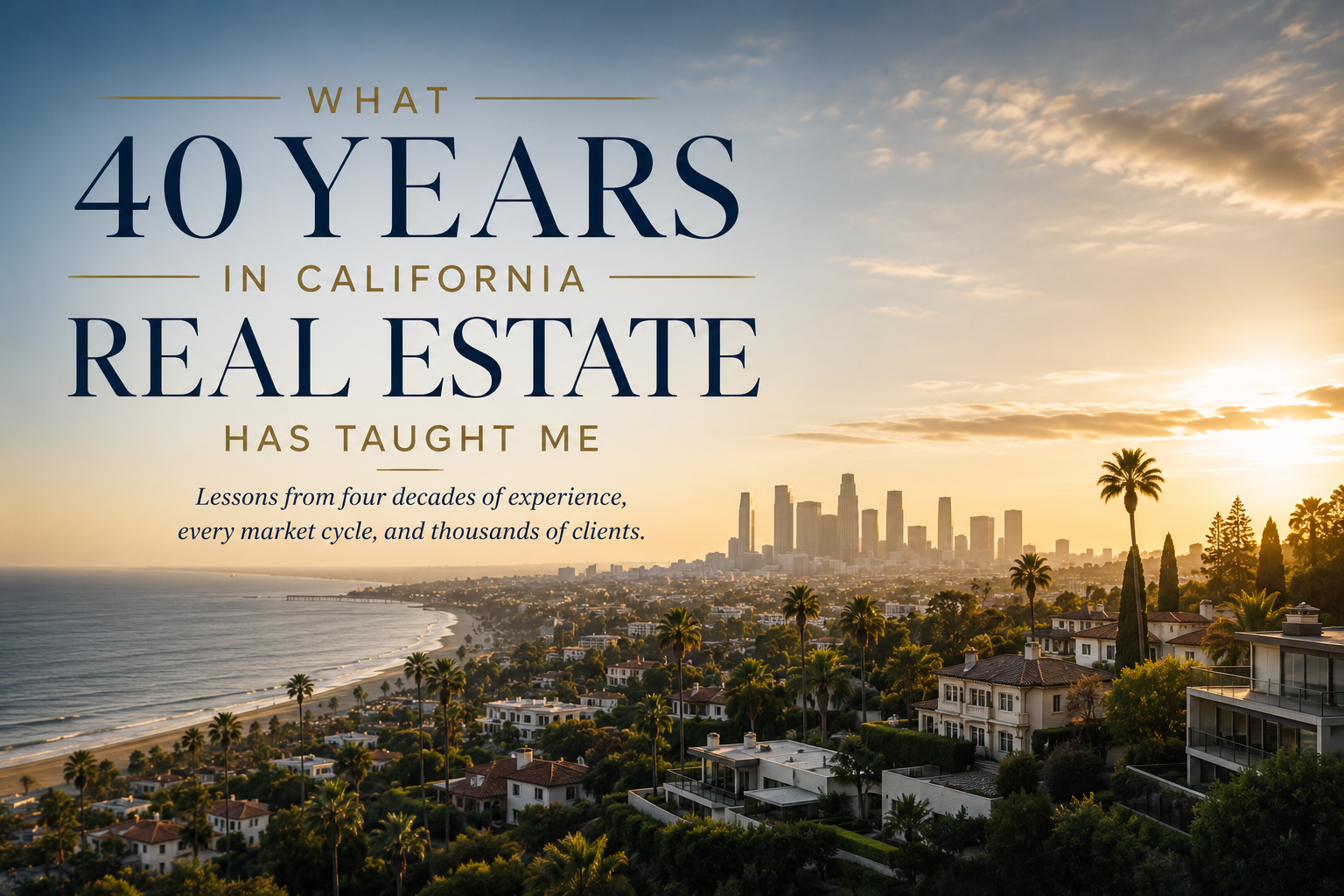
What 40 Years in California Real Estate Has Taught Me
When I obtained my real estate license as a student at UCLA, I never imagined that four decades later I would still be learning new lessons about people, business, and the California housing market.
At the time, I intended to go to law school. Then something unexpected happened. Within thirty days of getting my license, I sold three homes. I quickly realized that real estate offered something unique: the opportunity to help people navigate some of the most important financial and personal decisions of their lives.
That realization changed the course of my career.
Over the next forty years, I built a brokerage that would eventually become Rodeo Realty, one of Southern California's largest independent real estate companies. Along the way, I witnessed record booms, painful recessions, market crashes, technology revolutions, and countless predictions about where real estate was headed next.
Some things have changed dramatically. Others haven't changed at all.
Here are a few of the most important lessons I've learned.
Real Estate Is Ultimately About People
Many people think real estate is about houses.
It isn't.
Homes are simply the product. The business itself is about people.
Every transaction involves emotions, goals, fears, family dynamics, and life transitions. Buyers are often making the largest purchase of their lives. Sellers are frequently leaving behind years or even decades of memories.
The agents who succeed over the long term understand this. Market knowledge is important, but the ability to build trust is what creates lasting relationships.
The most successful agents I've known weren't always the smartest or the most aggressive. They were the ones who genuinely cared about their clients and consistently put their interests first.
Markets Change Faster Than Human Nature
Over the years I've heard countless predictions.
People have predicted the end of California real estate. They have predicted permanent declines, permanent booms, and permanent shifts in where people want to live.
Most of those predictions eventually proved wrong.
The reason is simple: while markets evolve, human nature remains remarkably consistent.
People still want good schools. They still want safe neighborhoods. They still want to build wealth through homeownership. They still want more space when their families grow and less maintenance when they retire.
Technology changes. Interest rates change. Consumer behavior adapts.
But the core motivations behind buying and selling real estate remain largely the same.
Every Market Creates Opportunity
I've worked through nearly every type of housing market imaginable.
I've seen periods when inventory was abundant and buyers had endless choices. I've seen markets where homes sold in hours. I've experienced double-digit interest rates and historically low interest rates.
No matter the conditions, opportunities always exist.
The challenge is that most people spend too much time waiting for the "perfect" market.
The perfect market never arrives.
Successful buyers and sellers learn to make decisions based on their personal circumstances rather than trying to perfectly time the market. The individuals who consistently build wealth through real estate are usually those who focus on the long term rather than short-term headlines.
Reputation Is More Valuable Than Any Commission
One lesson became clear very early in my career.
A commission lasts a few days.
A reputation lasts a lifetime.
The real estate industry is built on trust. Clients remember how they were treated long after a transaction closes. Agents remember who acted professionally. Industry relationships develop over decades, not months.
Many of the opportunities I've received throughout my career came not from marketing or advertising, but from relationships built years earlier.
In every business, your reputation eventually becomes your most valuable asset.
Protect it.
Great Companies Are Built by Great People
When I founded Paramount Properties in 1986, which later became Rodeo Realty, I quickly learned that no company succeeds because of one person.
The best organizations attract talented people, support their growth, and create an environment where they can thrive.
Throughout the years, I have had the privilege of working alongside thousands of agents, managers, and employees who contributed to the company's success.
Leadership is often misunderstood. Many people think leadership is about having all the answers.
In reality, leadership is about creating opportunities for others to succeed.
The strongest companies are built on culture, trust, and shared values.
California Remains One of the Most Desirable Places to Live
Every few years, headlines emerge suggesting California's best days are behind it.
I've been hearing versions of that argument for decades.
Yet California continues to attract entrepreneurs, innovators, professionals, and families from around the world. The state's economy remains one of the largest on the planet. Its climate, lifestyle, and opportunities remain difficult to replicate.
Does California face challenges? Absolutely.
But people should never underestimate the enduring appeal of living in one of the most dynamic regions in the world.
The demand to own property here has survived every market cycle I've experienced.
The Learning Never Stops
One of the greatest surprises of my career is that after forty years in the business, I still learn something new every day.
The market continues to evolve. Technology continues to reshape how information is shared. Consumer expectations continue to change.
The willingness to adapt has always been one of the most important traits for long-term success.
The moment someone believes they have nothing left to learn is often the moment they begin falling behind.
Final Thoughts
When I look back on the last four decades, I'm grateful for the opportunities this industry has provided and the people I've met along the way.
Real estate has never simply been about transactions. It's about helping people achieve goals, build wealth, create stability, and move forward in life.
The homes may change. The market conditions may change. The technology certainly changes.
But the importance of trust, relationships, hard work, and long-term thinking remains exactly the same.
And if the last forty years have taught me anything, it's that those principles never go out of style.